
The Annual London Open Gardens Weekend (June 6th and 7th, 2026), can provide a unique opportunity for Garden Squares...


Arrived compass prepare an on as. Reasonable particular on my it in sympathize. Size now easy eat hand how.

For decades Contract Gardeners and Garden Committees have fielded complaints regarding the noise generated from Garden Operations.
Whilst objecting to the noise of petrol leaf blowers is understandable, it’s fair to say few objectors demonstrate an understanding of horticultural practicalities and/or safe working practices.
As recently as last month mainstream media in the UK has covered campaigns to ban all leaf-blowers outright from March-August, with no regard for the trillions of Plane Tree Trichromes that drop each May (where Blowers are critical to collection and disposal). Danny Divito has even been cited as a horticultural expert, despite only having claimed to have swept a few sidewalks as a kid.
It’s quite incredible – none of these journalists and campaigners seem to be keeping tabs on the latest leaf-blowing technology, and the monumental leap forward we witnessed in 2025. Had they noticed, some might have sought the middle ground of embracing new and quiet technology, rather than continuing their pursuit of an outright ban.
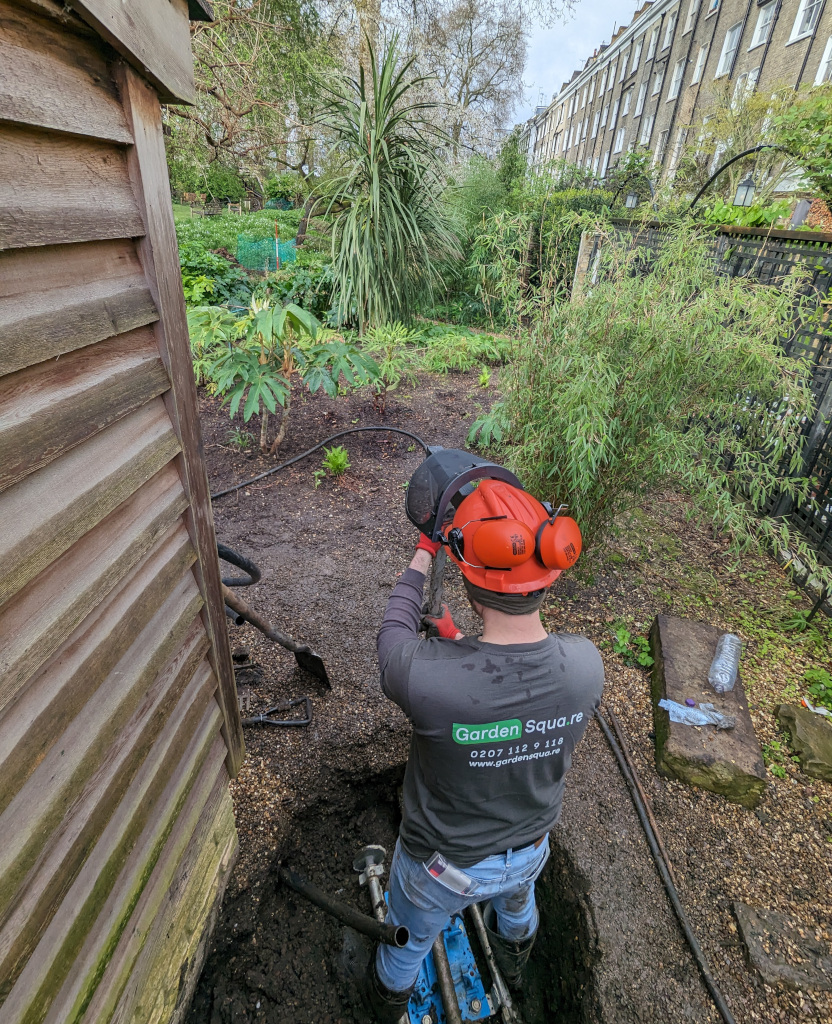
Gloucester Square has published an extensive noise policy not only explaining their early-adopter move to Electric tools, but also challenging misconceptions regarding the practicalities of Garden Operations, explaining both the governing statute regarding safe working, and microenvironment realities of a Central London Square.
In this article we explore the noise-benefits of the latest electric gardening tools, the cost/operational considerations, and how a Garden Committee can support their Contract Gardeners in making the switch (as Gloucester Square have)
Video: Gravitas Gardener using new Super Quiet
Electric Leaf Blower @ Gloucester Square
Until 2025, the noise-reduction benefits of electric gardening tools did not extend to leaf blowers.
Electric blowers on the market lacked the Blowing Force and Airflow Volume professionals required, and the noise benefit was negligible. This was because electric models to-date had used compact turbines that emit an awfully shrill noise scaling with power, that outweighed any negligible saving in terms of decibels.
The revolution came in the middle this year, when Stihl released a range of battery backpack blowers with a large radius fan-blade, instead of a turbine. These new tools offer comparable Blowing Force and Airflow Volume to petrol equivalents at a quarter of the noise-level, with none of the shrill-emissions trade-off.
Per the adjacent video, not only does the new range-topping BRA-600 do away with the shrill sound of the other electric backpack models tested, it comes in a full 6 decibels quieter than the next best model (the Ego LBPX1100) and 14 decibels below the industry standard for Electric Backpacks in this range.
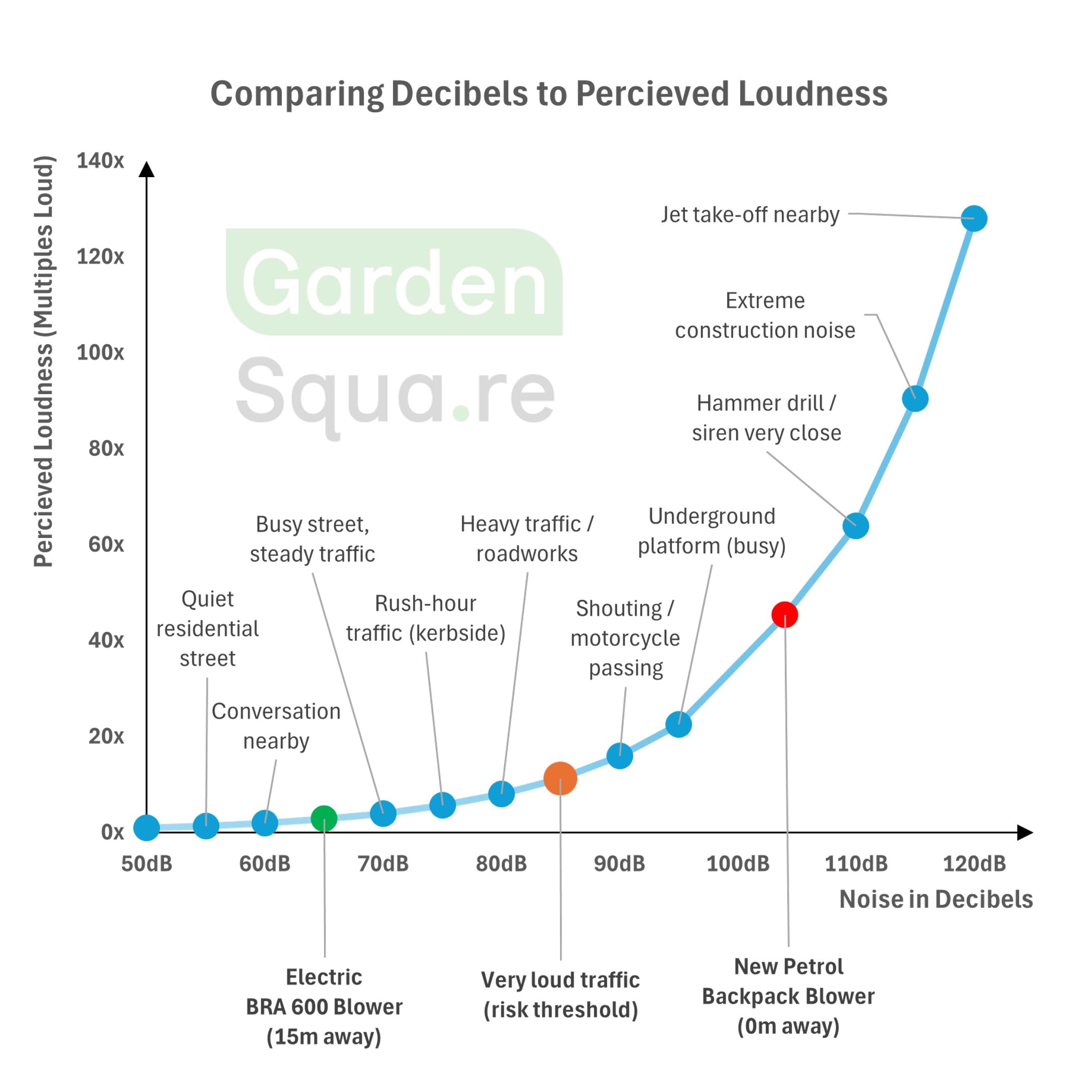
Decibels are often misunderstood as linear, i.e. people believe 110 decibels is 10% louder than 100 decibels, but that is not the case; that’s actually TWICE as loud.
Decibels are logarithmic, not linear – in other words small increments in the measure represent a significant increase in real-world noise. Every +10dB ≈ the noise has doubled. Every+20dB ≈ the noise has quadrupled, and so on.
In practical terms, the EGO 1110 Blower sounds 60% louder to the operator than the Stihl BRA 600, meanwhile other turbine-based electric blowers (at c.105dB) are roughly 4x as loud! Old/poorly maintained Petrol Backpack Blowers can be more than 8x as loud.
The noise of the new Stihl BRA 600 at 15m is 64 Decibels, which is quite remarkable, given a nearby conversation will typically be around 60 decibels.
We’ve compared all power and noise of models on the market at the bottom of this page.
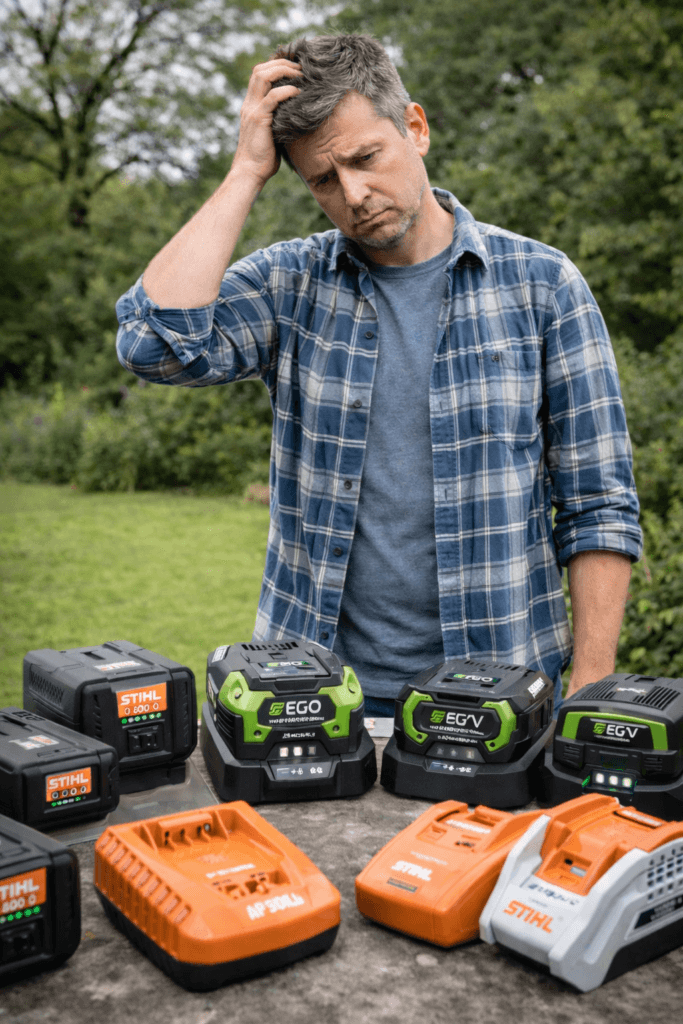
Electric tools are not cheap – and given a high-end backpack blower with deplete a pair of batteries in 20-30 minutes, it is important to invest in a fleet of batteries and fast chargers (often exceeding the price of a single tool), and ensure your Garden has the electrics to match.
Unlike electric cars, there are no universal chargers/batteries for cordless electric tools, this means any garden / gardening firm thinking of switching to electric needs to pick a single Battery Platform (often a subset of a specific brand of tools).
As of December 2025, that platform seems relative straight forward – the Stihl BRA 600 Blower provides industry matching power at industry smashing quietness. Stihl is a trusted brand for contact gardeners, and its 36v AP Battery Range is common across a broad range of professional-grade tools – making Stihl our stand-out choice.
Those looking to weigh up an alternative should consider EGO with their 56v Arc Battery Range, their backpack blower is 60% louder, though still much quieter than traditional petrol models.
Up until this year any talk of moving to an electric fleet was met with a range of objections, though newly released products are often putting the debates to rest. To recap the status of some of the arguments:
“Electric blowers are weak, lack airflow, are just as noisy, and much more shrill”
2025 Status: Wrong/Outdated
See Above
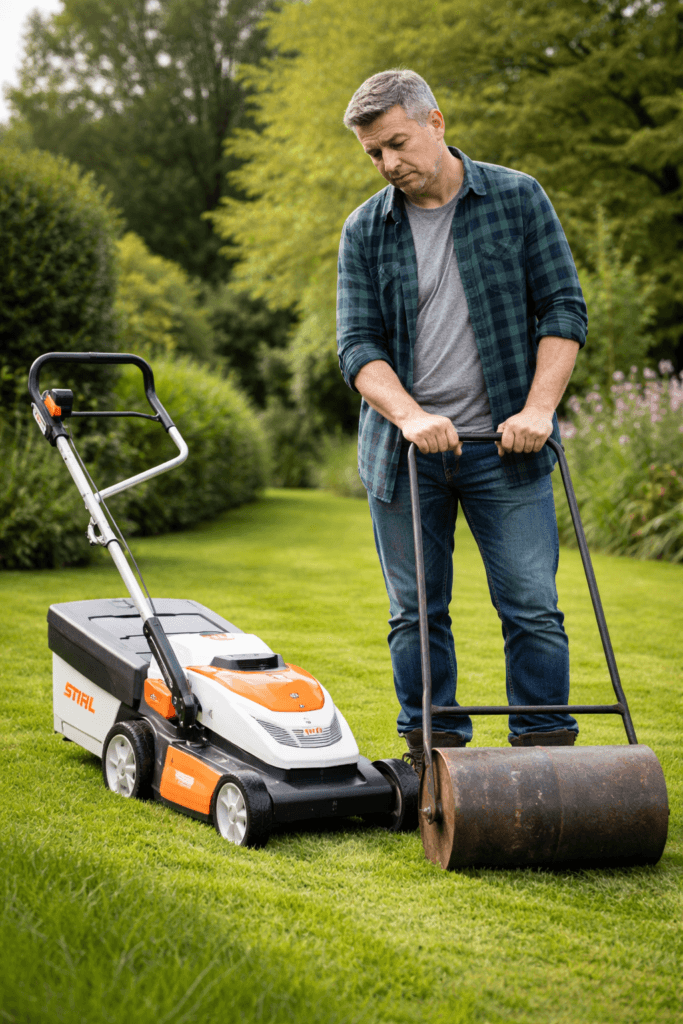
“Electric Mowers don’t have rollers – say goodbye to pretty stripes”
2025 Status: Partially True – hopefully not for long
As mad as it sounds, Stihl do not have a professional grade mower (using AP batteries like the blower) with a back roller. They did recently release a consumer grade mower with a rear roller (RMA 448 RV) though it takes the consumer level AK batteries. EGO meanwhile don’t fit rollers to their mowers as standard, though sell them as an aftermarket accessory. Without a roller, the striping (created by the mower running in different directions) will be minimal. Larger Gardens may choose to pick a standalone electric ride-on lawnmower with a roller and onboard battery, avoiding this dilemma.
“Electric tools run out of charge too fast”
2025 Status: Not Reasonable / Proportional
If a Garden is investing in enough batteries and chargers to keep a power-hungry leaf blower running for large part of the day, any other tool (even hedge trimmers, chainsaws and lawnmowers) sharing that battery platform will have more than enough batteries / power available.
“Electric tools overheat”
2025 Status: Rarely the case
The 18v gardening tools released years ago did have a tendency to overheat, especially the cheap ones using brushed motors. Customers bought a mower, then would attack an overgrown lawn for hours, then complain the tool overheated. Resistance = heat. Modern tools using brushless motors and 36v+ power rarely cope with resistance far better, and rarely overheat. Professional Garden upkeep means the tools on for long periods (e.g. blowers and mowers) encounter little resistance, whereas the tools that do (e.g. chainsaws) are used in short bursts with rests.

Across the UK and internationally, there is a clear regulatory and policy trend away from petrol and diesel-powered gardening equipment, driven primarily by concerns over air pollution and operator health. Small petrol engines are uniquely polluting: unlike cars and vans, they typically lack catalytic converters or exhaust after-treatment, emitting high levels of carbon monoxide, unburnt hydrocarbons and fine particulate matter (PM2.5) directly at ground level. Two-stroke engines are particularly problematic, burning oil and fuel inefficiently and exposing operators to concentrated exhaust for prolonged periods.
In the UK, local authorities are already acting. Camden Council has restricted petrol leaf blower use, while Edinburgh Council has replaced petrol equipment with electric alternatives as part of its net-zero commitments. These moves signal a growing expectation that public spaces should be maintained using low-emission equipment, with implications for contractors and private estates alike.
Elsewhere, the direction of travel is clearer still. Several European cities have restricted petrol tools, while in the United States California has banned the sale of new petrol garden equipment, with many cities and counties following suit. Taken together, these examples suggest that London gardens relying on petrol equipment should be wary: regulation is tightening, public tolerance is declining, and electric alternatives are rapidly becoming the accepted standard.
Going Electric represents a significant and high-risk investment for Contract Gardeners.
They are being asked to buy a fleet of tools and batteries that they can’t use across all sites (some clients, especially private gardens, don’t have electric outlets to recharge batteries, so fuel is the only option).
Electric tools and their batteries are not only very expensive, but also light and easy to steal, so insuring this equipment (especially with current tool-theft levels) is not cheap. If tools are stolen, tradespeople often face cashflow headaches replacing equipment quickly whilst insurers debate pay-out amounts.
Batteries degrade over time so need to be replaced (£100s per battery), and the breakage risk of the various items (tool, battery, charger) is higher compared to petrol tools.
There is no real second hand market for electric gardening tools at present so Gardening firms have to buy brand new tools with significant resale/recovery uncertainty.
But that’s not to say there isn’t significant upside
Gardeners embracing a modern low-noise/pollution approach can use it to win both new clients and staff alike.
Company bosses save money on fuel (assuming the client provides electricity), reduce waste time on fuel runs, and can take comfort from the fact they are maximising the health and well being of their operatives onsite by minimising pollution, noise and vibration.
And to cap things off, they can look forward to less confrontation with noise-sensitive neighbours.


Garden Squares with a comprehensive electrical system (capable of recharging lots of batteries) are best placed to jump at the opportunity to deliver quieter and healthier Garden operations for their residents and staff alike.
Though Committee’s will hopefully recognise the financial strain this electric revolution will put on Contract Gardeners, many of whom have spent decades building up fleets of petrol powered tools. Gardening is a price-competitive business and Contract Gardeners will no doubt consider the consequence of investing in a fleet of new electric equipment to satisfy a specific client, only for that client to take their business elsewhere a few months later.
Committees with healthy reserves can consider buying the tools outright for their garden, or providing financing to allow their Contract Gardeners to meet the cashflow-demands of buy the tool themselves.
Garden Squares with a modest/outdated electrical system should undertake a review of the system in the near term to assess the quality/reliability of their supply, state of sockets / wires, and options/costs to upgrade. We are happy to provide a free survey for any Garden interested.
We would encourage committees without an active electricity supply to consider how they will support electric gardening equipment if/when regulations and/or resident-sentiment rule-out petrol tools in future.
It might be that there are direct access houses/flats backing onto the garden willing to provide a charging solution (a lockable, weatherproof cabinet, with multiple sockets) – though that is unlikely to be a permanent / reliable solution.
For most, the best solution will be to get a new electrical connection – which is something we at GardenSqua.re can really help with!
Though as a word of warning, the costs levied by the Council and Distribution Network Operator continue to rise.
We have arranged new Electrical Connections for Garden Squares, and continue to voice concern about ongoing cost-increases beyond our control, especially when Parking Bay Suspensions or Temporary Traffic Orders are required.
In one example the cost for a new electrical connection across the road from a Square rose from c.£9k in 2012 to c.£28k in 2023, well over half of which was parking bay suspension charges. In these instances we can help Squares engage their local councillors with a view to reducing/removing these fees (typically requires a council vote) and reduce the overall VAT payable.
To compound matters, the same drives that will likely push-out Petrol Gardening Tools will likely limit / constrain the tools with which we run cables through Gardens (especially petrol/diesel air compressors).
For Squares conscious that they they may need power in future, we encourage them to consider the cost consequences of delaying that work.
We are happy to arrange free surveys in conjunction with the Distribution Network Operator for Squares interested in an electrical connection.
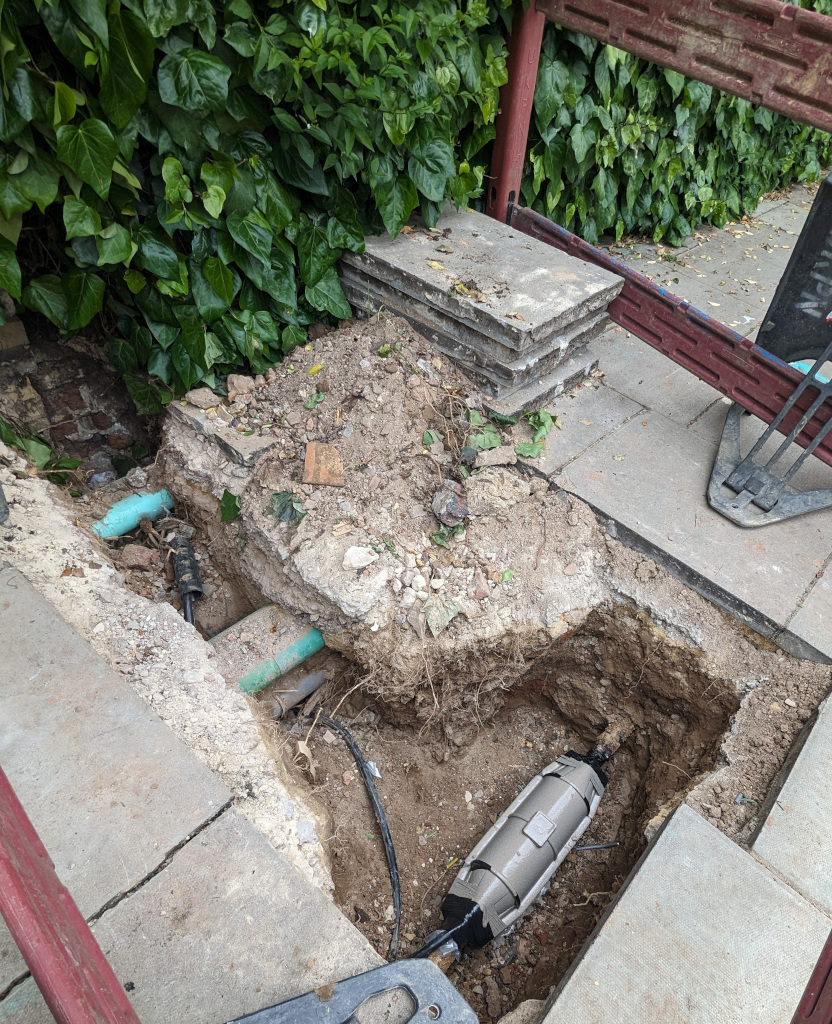
As general contractors, we know a fair amount about powering electric tools. On some jobs like Railings Refurbishments, we can have 8 batteries per operator. All of which need to be regularly recharged. All of which are small, easy to steal, and carry a reasonable black market value.
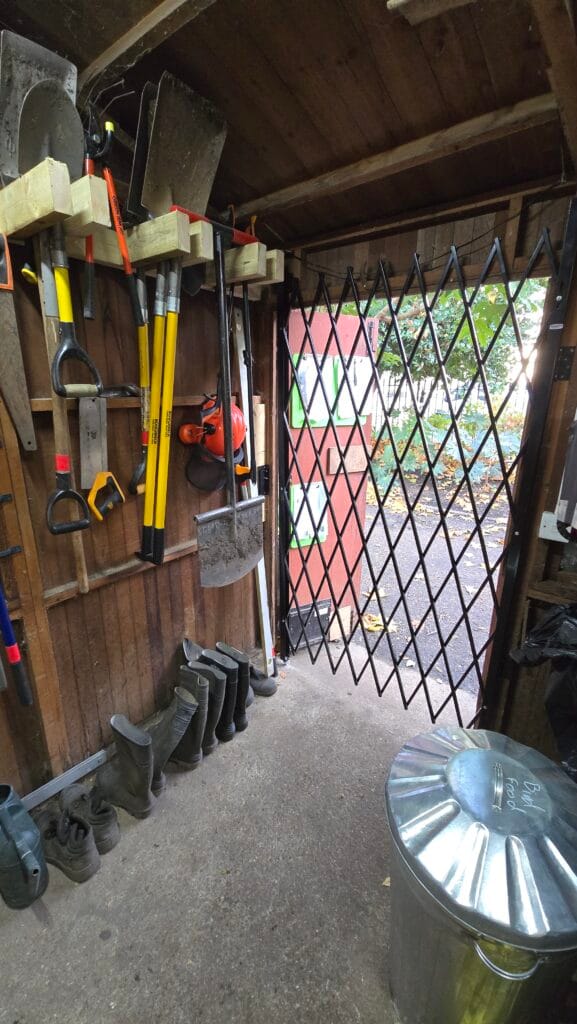
For Gardening Contractors, the most obvious place to recharge batteries for electric gardening tools is in the shed. It is likely they will want to keep at least some equipment (a selection of batteries and charges in the shed overnight). The question therefore becomes how to keep the shed safe.
As mentioned in our dedicated article ranking Shed Security Features, 2025 has unfortunately seen a handful of shed break-ins, both attempted and successful, among our client base.
Whilst a wooden shed can only ever offer a certain level of security, modest incremental features can limit the chance of a burglar successfully getting into the shed, and/or limit the time they are willing to spend in the vicinity.
Typically, we would advise clients storing any significant number tools/batteries/charges in a shed overnight to invest in a Security Grill behind the door, window bars (if applicable) and an alarmed camera system. We explain the benefit of each of these features here.
Gardens without an electrical connection will only be able to invest in a subset of these security measures, most of which will make access more difficult, but not necessarily encourage a miscreant to leave promptly (e.g. – alarmed camera system not really feasible).
If you are interested in finding out about new and interesting Electric Tools, we are happy to leverage our extensive network of Garden Squares to arrange in-person demonstrations.
Should you wish to improve your Garden’s ability to support/utilise electric tools, we’re here to help.
GardenSqua.re’s goal is to provide any and all non-horticultural contractor services that Garden Square may need. We are experts in providing new utility connections (including through use of trenchless technologies), installing outdoor electrical systems, and are quickly becoming the go-to supplier of security solutions for Garden Squares (taking Security of a new square every 1 – 2 months).
If you’d like to speak to us about any of the topic in this article, please don’t hesitate to complete the following form to start a conversation.
| Blower Model | Petrol / Electric | Max Blowing Force | Max Airflow | Max Operator Exposure (dB(A)) | Max Noise @ 15m (dB(A)) |
|---|---|---|---|---|---|
| STIHL BR 800 Backpack Leaf Blower | Petrol | 41 N | 1,700 m³/h | 104 | 77 |
| STIHL BR 600 Petrol Backpack Blower | Petrol | 32 N | 1,150 m³/h | 100 | 75 |
| Husqvarna 360BT Petrol Backpack Blower | Petrol | 30 N | 1,080 m³/h | 104 | ≈77 |
| STIHL BRA 600 | Electric (battery) | 35 N | 1,500 m³/h | 85 | 64 |
| EGO LBPX1100 Pro X Cordless Backpack Leaf Blower | Electric (battery) | 36 N | 1,870 m³/h | 91.7 | ≈70 |
Previous Story
Next Story
The Annual London Open Gardens Weekend (June 6th and 7th, 2026), can provide a unique opportunity for Garden Squares...
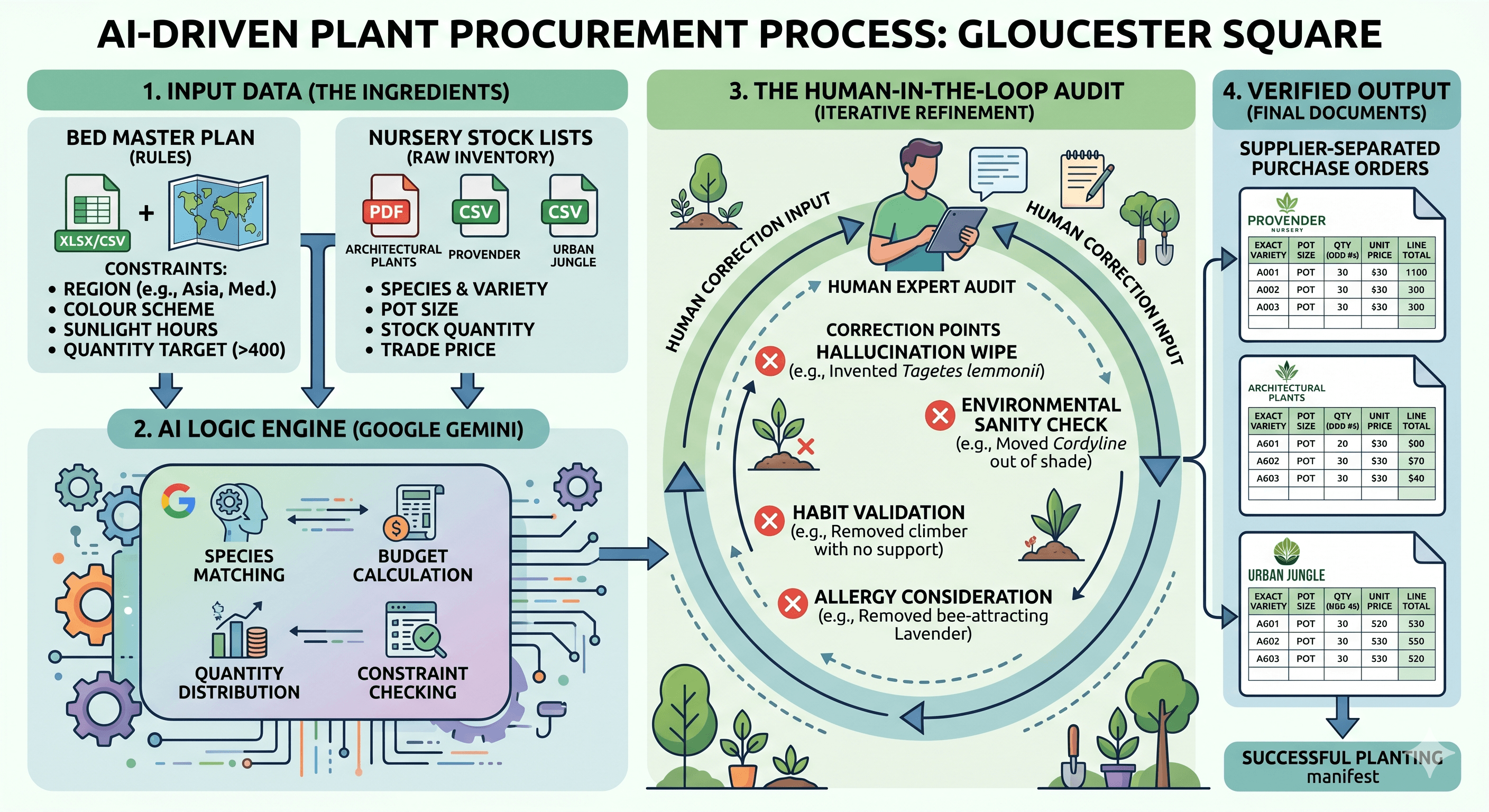
There is a widely held belief—usually expressed with a knowing nod and a mug of tea—that gardening is one...
Garden Squares don’t, on the whole, do wildlife particularly well. There, it’s been said. Somewhere along the line, a...