Moral and Legal considerations for operating a Security Camera system in a communal garden.

One of the greatest barriers to securing Garden Squares is the difficulty inpositioning security cameras. In this article we explore the methods wetypically use to mount and maintain power to cameras.
Challenges of Mounting Cameras in Garden Squares

Placing Cameras in Communal Gardens can be particularly challenging, particularly because they are:
- Sensitive environments: The Urban Trees in Garden Squares are important assets, heavily protected by local authorities. Tree Protection Officers are unlikely to support mounting cameras directly to Trees, particularly because even Mature Trees (like the 180 year old Plane Tree pictured) will grow and break/consume mounts over time.
- Changing environments: Cameras may be blocked by the growth of existing trees / shrubs, or the placement of new trees/shrubs over time. Tree Protection Rules (BS5837) make clear that Trees should not need to be pruned to accommodate the position of CCTV cameras.
- Visually Precious: Many Garden Squares have been meticulously cared for over many generations, therefore incongruous camera equipment / support infrastructure can be met with fierce opposition.
Solution 1: Flexible Tree Mounts
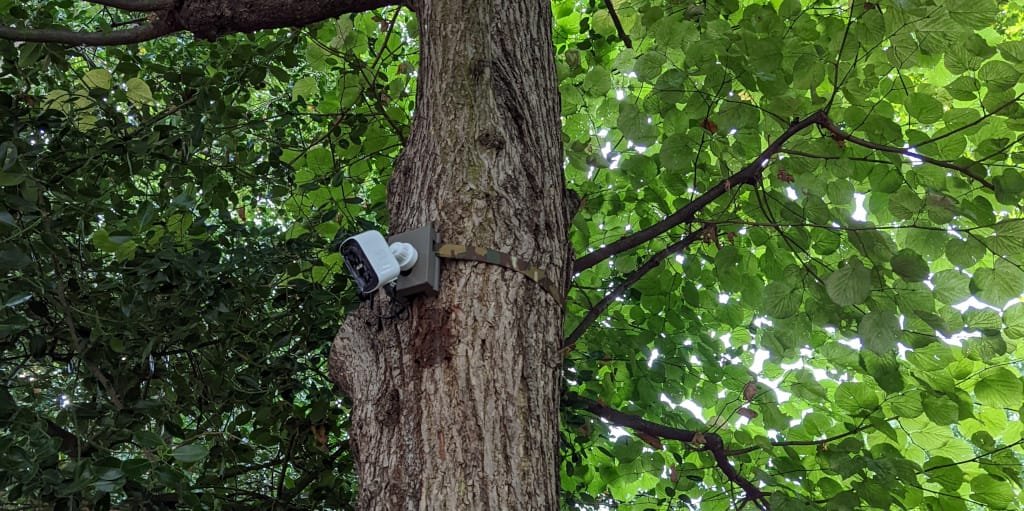
Our favoured approach is to attach each Camera Mount to a rust-proof Aluminium Mount, that are held against a tree with a Camouflage Turnbuckle Strap, offering many benefits, not least:1.
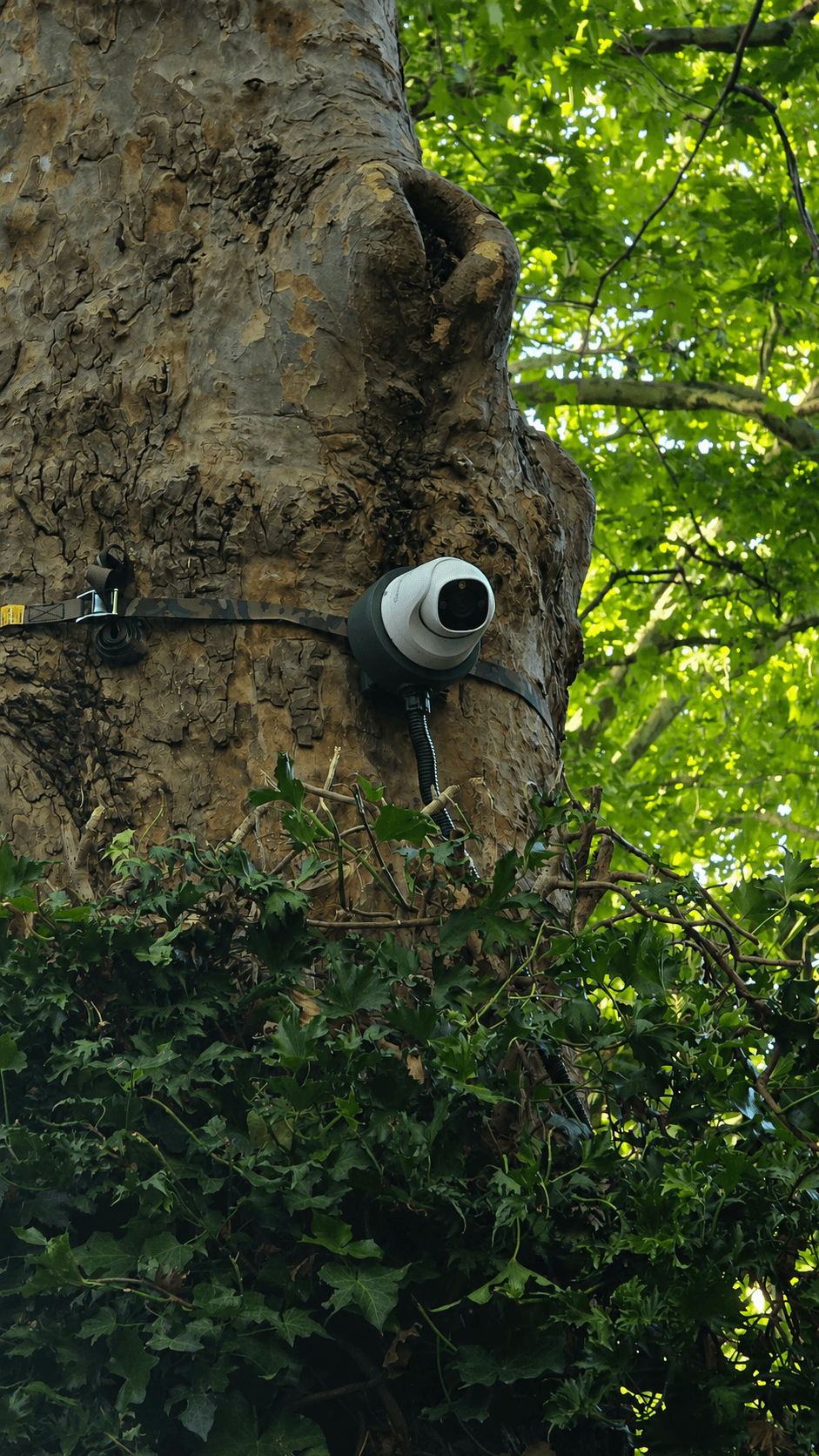
- Low Visual Impact: The mount and the strap blend-well with the vast majority of trees. Cameras and their mounts can be coloured for less visual impact (though typically it helps for the camera itself to be noticeable for deterrent purposes)
- Non-Invasive: From our experience the majority of Tree Protection Officers object to invasive mounts that penetrate the bark of trees(even if rust-proof fixings are used). Our straps and aluminium mounts don’t penetrate or damage the tree.
- Fully-Flexible: The mounts can be adjusted/removed simply by loosening/undoing the turnbuckle strap, allowing for them to be adjusted/relocated as the Garden changes around them. The equipment can be installed on trees of practically any size.
- Non-Permanent: If the environment around the cameras changes, so to obstruct their field of view, they can simply be moved.
- Fast Installations: Whilst some preparation work is required (toattach the camera mount to the aluminium block), the time requiredto install the camera onsite is kept to an absolute minimum.
Solution 2: Classical Lampposts


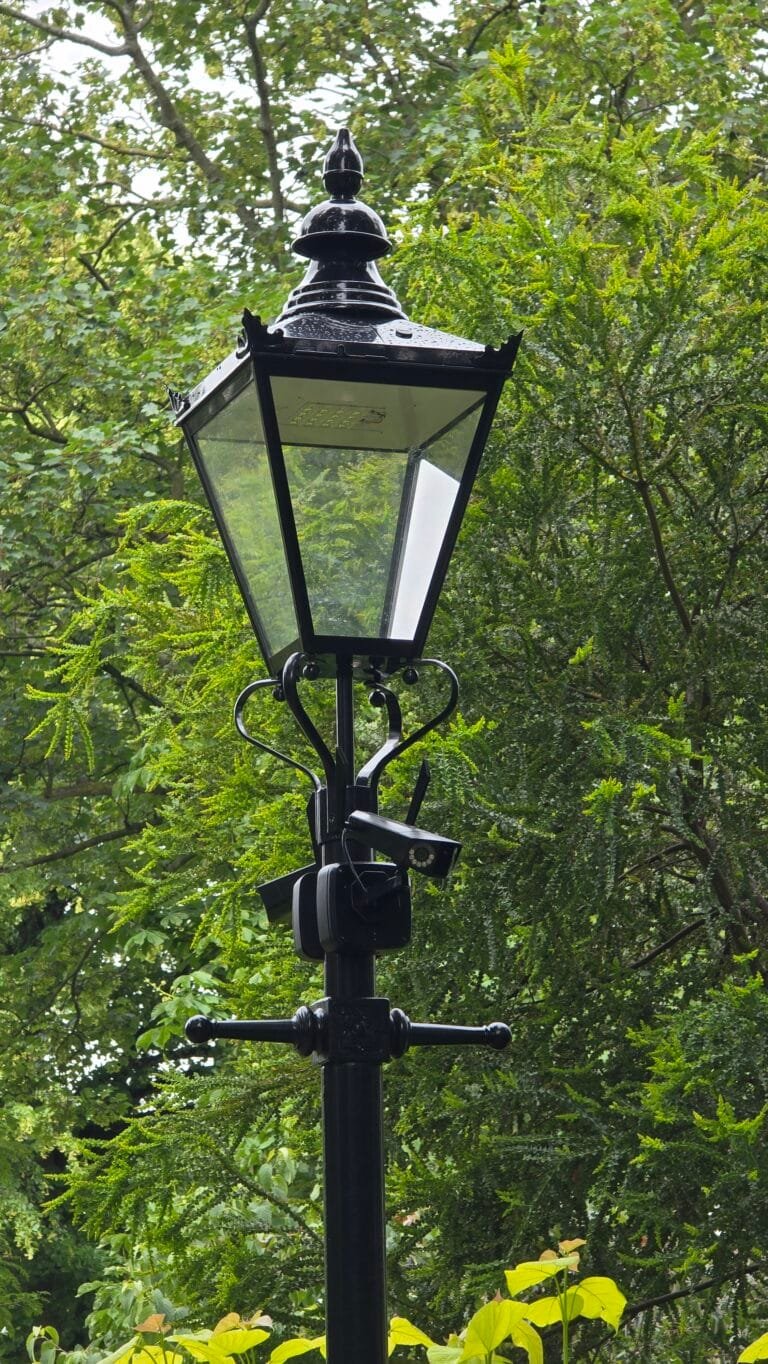
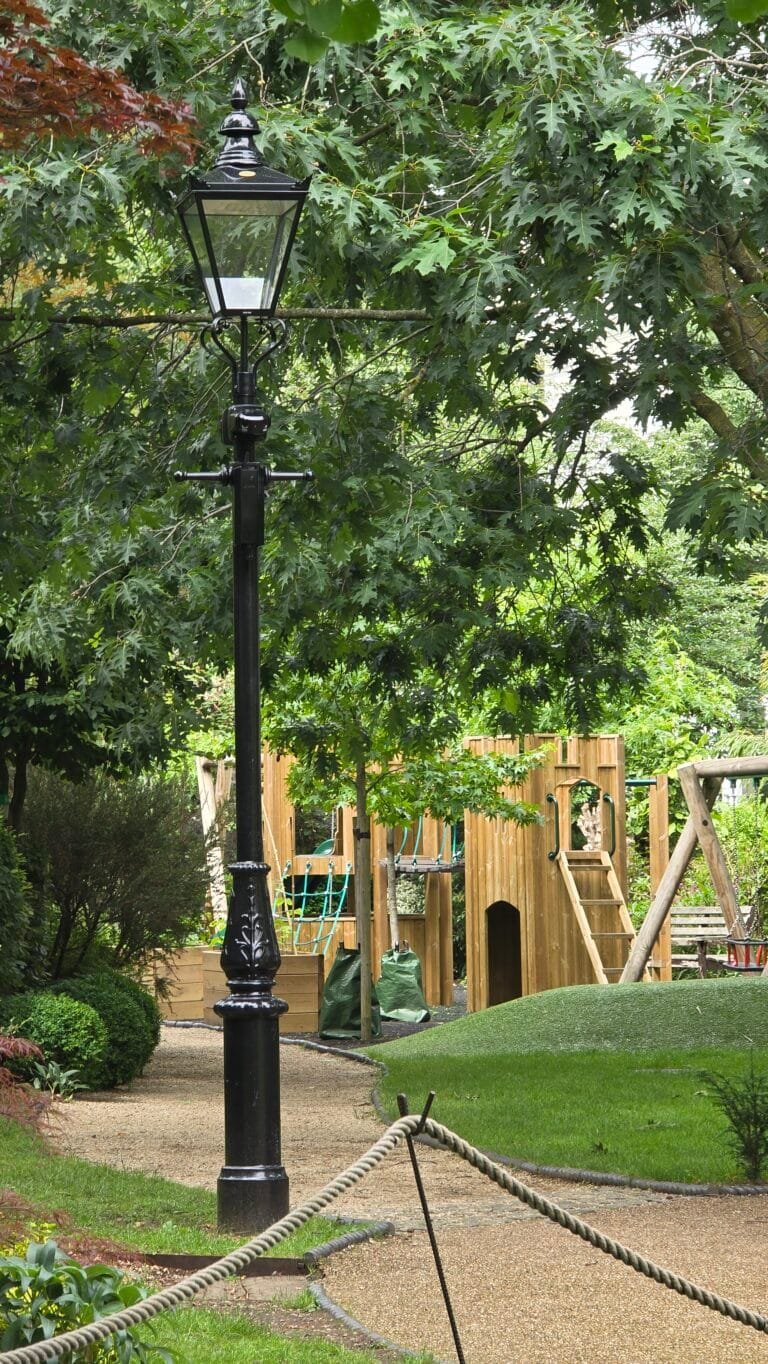
Local Authorities will typically be open to allowing the installation of Victorian Style lampposts in and around Garden Squares, offering several unique benefits:
- Optimal Locations: Lampposts can be positioned away from trees and shrubbery so to maximise surveillance coverage and minimise interference. With the advent of super-wide angle (180-degree Field Of View), the value of standalone locations has increased significantly.
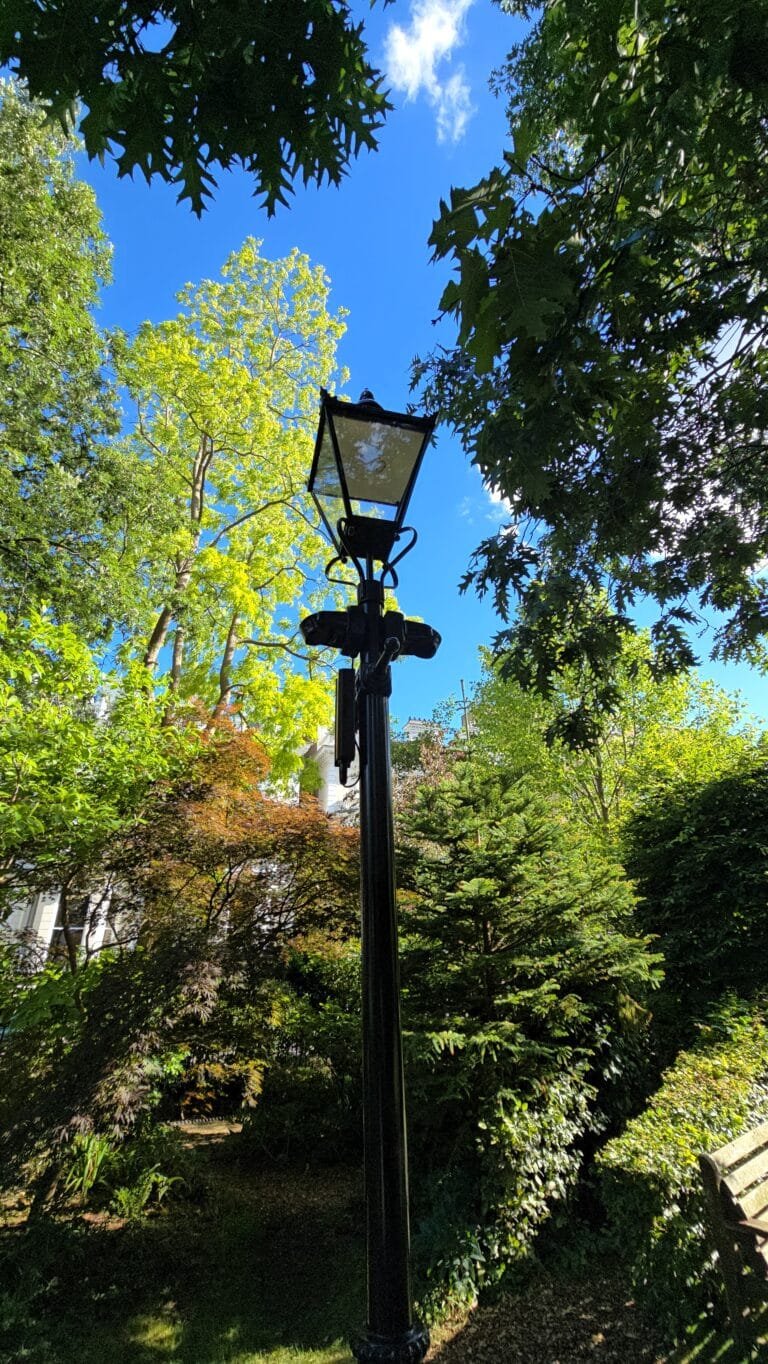
- Optimal Mounting Height: 3.6-4m Lamp posts typically provide a camera-mounting location between 3-4 meters from the ground, which is ideal for surveillance.
- Neat and Discrete: As the photos show, cameras are most discrete when mounted to lampposts. Plugs, converters and cables can all be installed/run inside the lamppost, meaning there is nothing on display other than the lamppost and the camera. We typically use Black cameras so to compliment rather than contrast the lamppost.
- Less Maintenance: Whereas trees grow over time (requiring tree mounts / straps to be adjusted), lampposts remain unchanged, lessening the need for regular maintenance.
- Added Lighting: The light cast from the Lamppost can not only enhance the Garden after dark, increasing ratepayer benefit/utility from the garden; the position of the light (above and behind the cameras) is perfect for lighting the captured field of view, increasing the quality of footage captured.
Running Cables to the Cameras
The type of cameras deployed will dictate the cables required. Battery Cameras typically require a small 5v cable to recharge the onboard battery, supplied in Lengths upto 10m. Garden Committees looking to minimise visual disruption can run the wire by itself, though this may be damaged by foxes, squirrels and the like over time. Running in a small plastic conduit (from the nearest power source) is advisable.
For 24/7 cameras, we use only armoured power (for WiFi Cameras) or armoured CAT5e data cables (for POE cameras). Whilst some companies will happily install unprotected cables in plastic conduit, these cables are often not externally rated, and much more prone to failure over time – therefore are not worth the modest cost saving. Such contractors also rarely use the right conduit (rated, smooth-walled of adequate internal diameter), instead installing cheap ribbed conduit that degrades and breaks over time, making it impossible to run new wires without further trenching / boring.

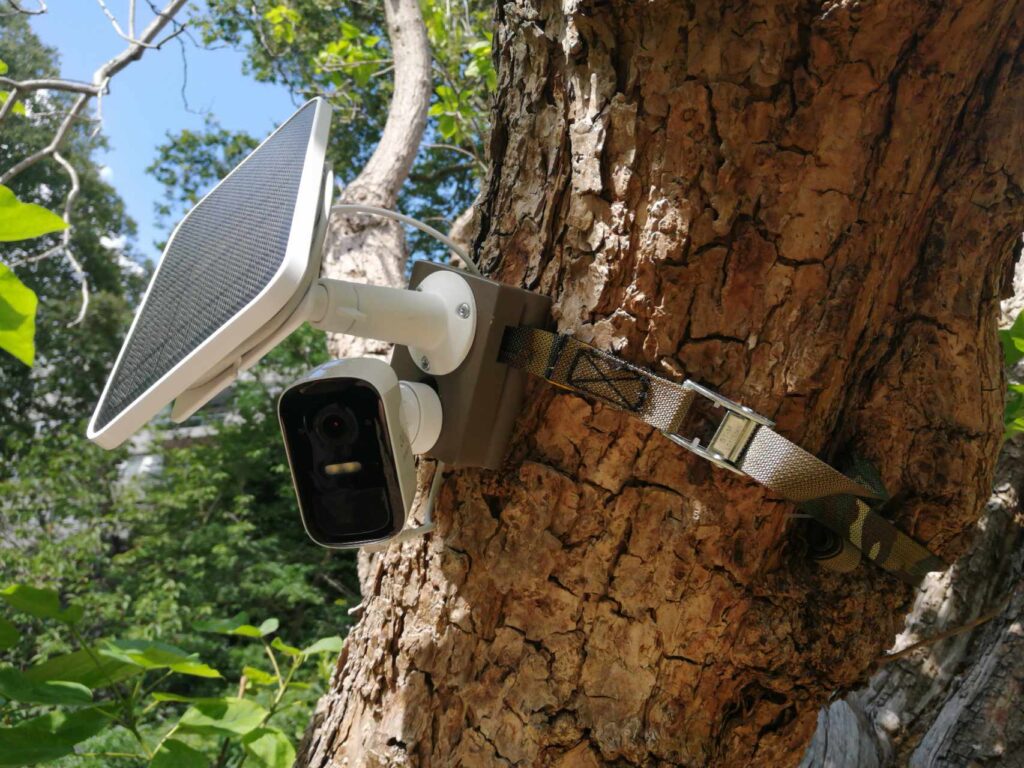
Powering Cameras with Solar Panels

The aluminium mounts we recommend can also support a solar panel and camera on the same mount.
They’re great in theory, though in practice solar panels in Communal Gardens rarely provide sufficient charging power year-round for (low consumption) motion-activated cameras, because:
- Few places in Communal Gardens receive 8+ hours a day ofsunshine, owing to the shade cast by trees / buildings
- Further charging deterioration can be caused by leaf-fall, plane tree trichomes, birds mess, etc
- Motion-events can be frequent in Gardens, and therefore the power consumed by motion-cameras, tend to be quite high (moving branches, animals, branches). Even if the cameras are set to filter-out these events, the lion’s share power is consumed by the motion sensor being triggered, rather than saving the recording.
Placing Cameras at the Correct Height
For as long as there have been security cameras, there has been a debate about how high they should be positioned. Higher cameras are less likely to be stolen/vandalised, but lower cameras are more likely to capture more detailed, useful images of the suspected culprit.
From those interested – IPVM have published a detailed study into the impact of camera mounting heights.
Motion cameras add a another level of camera to the debate, as above a certain height, the performance of the motion sensor deteriorates.
On balance, our preference is to place the camera just out of reach of a potential vandal, at between 10-12ft above ground.

Previous Story
Festive Light Tips and Tricks
Next Story